
Dado Banatao: Silicon Valley visionary, science and education champion
More than a place where electronics and web companies congregate, Silicon Valley is in fact the embodiment of an innovative culture driven to change the world. And since the late 1980s, a Filipino has been a huge part of that revolution.

Filipino-American Dado Banatao contributed to innovations in personal computing. © Johannes Plenio/Unsplash
About this project
I wrote this as Features Editor at Entrepreneur Philippines, where I covered technology, finance, and social enterprises from 2010 to 2013, before I shifted to a development career. Dado Banatao was one of the most influential Filipinos in global technology — a Silicon Valley pioneer who helped make personal computers possible, long before most people knew his name. I was a young editor when I interviewed him, and speaking with someone of his stature, who remained so grounded and so committed to giving back, was genuinely humbling. Dado passed away on 25 December 2025, at 79. This story feels more worth keeping now than ever.
A lot of the world’s technological progress in the last 50 years can be attributed to that area within 30 miles around Santa Clara county in California, popularly known as Silicon Valley. More than a place where electronics and web companies congregate, Silicon Valley is in fact the embodiment of an innovative culture driven to change the world. And since the late 1980s, a Filipino has been a huge part of that revolution.
The most successful Filipino in Silicon Valley, computer engineer Dado Banatao went to the United States by luck but succeeded through brilliance and persistence. And what exactly did that give us? Winston Damarillo, chief executive officer and co-founder of MorphLabs, says about 30 percent of every computer in the world has a Banatao component in it.
“We were just fooling around with computers,” Banatao says of his team and contemporaries, which includes Steve Jobs. In one of those hacking sprees, Banatao produced an architectural innovation that crunched over 150 chips on a personal computer into just five.
Thanks to his efforts to link integrated circuits, we now have smaller and much powerful single chips. Banatao was also responsible for the first Windows Graphics accelerator chip for the PC so you can enjoy your games with stunning visuals. He’s also the guy who made then military-controlled global positioning system (GPS) accessible to laymen.
“That feels good,” Banatao says modestly. “What engineers do and what we strive for is to design something that people will buy. It’s a different kind of high when you see people use your design. That’s amazing.”
More than the margins
To have achieved what he had considering his humble beginnings in Cagayan province was amazing, too. Of the three companies he put up in Silicon Valley, Chips and Technologies was bought by Intel for $430 million, while S3 had the fastest IPO (initial public offering) in the US stock market history — only 22 months from Day 1 to going public. He was then named Master Entrepreneur of the Year by Ernst and Young, Inc magazine, and Meryll Lynch in 1997.
By then, he was already looking into helping other startups make it in Silicon Valley, both as an investor and a mentor. “I wanted to become a venture capitalist because I wanted to leverage my experience as an entrepreneur in funding products and backing other entrepreneurs, not one at a time but multiple of them. And the only way to do that is to invest and own just a part of the company,” he says. After serving as a venture partner at Mayfield Fund, he formed Tallwood Venture Capital in 2000.
Investing primarily in semiconductor-related companies, Tallwood has helped over 30 companies since it started, four of which has gone public and six were acquired. Banatao and his partners are managing $600 million and helping around 15 startups at present.
The 66-year-old is always excited by challenges: “It’s so invigorating to get involved in technology, and I still feel and think like an entrepreneur even when I’m an investor.” He admits to be very hands on when managing a company, but not to secure returns, but to make sure the partnership produces a great product. From 2003 to 2006, he was part of Forbes’ The Midas List of technology’s best investors.
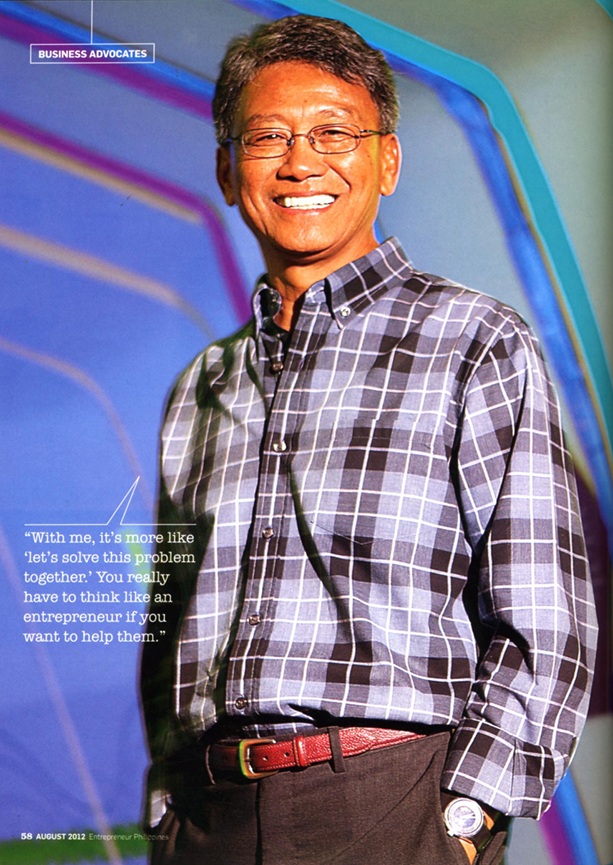
“A lot of venture capital firms didn’t go through the process that I went through, so for them it’s simply a financial transaction. With me, it’s more like ‘let’s solve this problem together.’ I think that’s why I have more successes in investing in companies than others; you really have to think like an entrepreneur if you want to help them,” he explains.
Giving back in a big way
It is also this “think like an entrepreneur” mindset that pushed him to create the Philippine Development Foundation, a non-profit focused on building an ecosystem of science and technology-based entrepreneurship to boost social and economic development in the country.
“We often forget about the basic foundation of the economy, which is producing valuable products created by scientists and engineers. Without it, all the other professions will have a hard time getting jobs: there would be no companies created because there are no products being created and there are no engineers creating those products,” says Banatao.
Among the many projects of PhilDev is the SuperFund, a joint effort with government, academe, and corporate sponsors that benefits students in high school, college, and graduate studies. Over 100 students enrolled in science and engineering courses are set to be awarded P1-million worth of scholarships via SuperFund.
“Other Asian countries have this science culture, and we still don’t have it. Part of the goal here is to show successes and hopefully excite students or those that are naturally inclined in science and math to go into the technical field,” he says.
Banatao admits there’s a lot of work to do to create this science culture, and not even his organization or himself could provide for all the country’s needs. Thus, PhilDev is urging the government and industry to do their part.
“The government has to promote and emphasize science and math, and we need to train and put in qualified teachers,” he says.
Industry, on the other hand, must also contribute to this collective obligation by “pouring in more risk money like the way we do it in Silicon Valley.”
A more direct influence on these young people, parents can become the best support or worst hurdle in discovering the country’s next generators of innovators, says Banatao. “Parents should get out of the way of their kids and their natural tendencies. This is my belief: When you do what you like and you do it constantly and you spend the time to do it, you should be good at it. Anything that you don’t like to do and you’re forced to do, you’ll never be good at,” he explains.
When these stakeholders come together and create this ecosystem, “a lot of bad things like corruption will be taken out naturally because people will not think of cheating because they’re okay,” he says.
“If you want to be part of this revolution, you work hard and give back.”